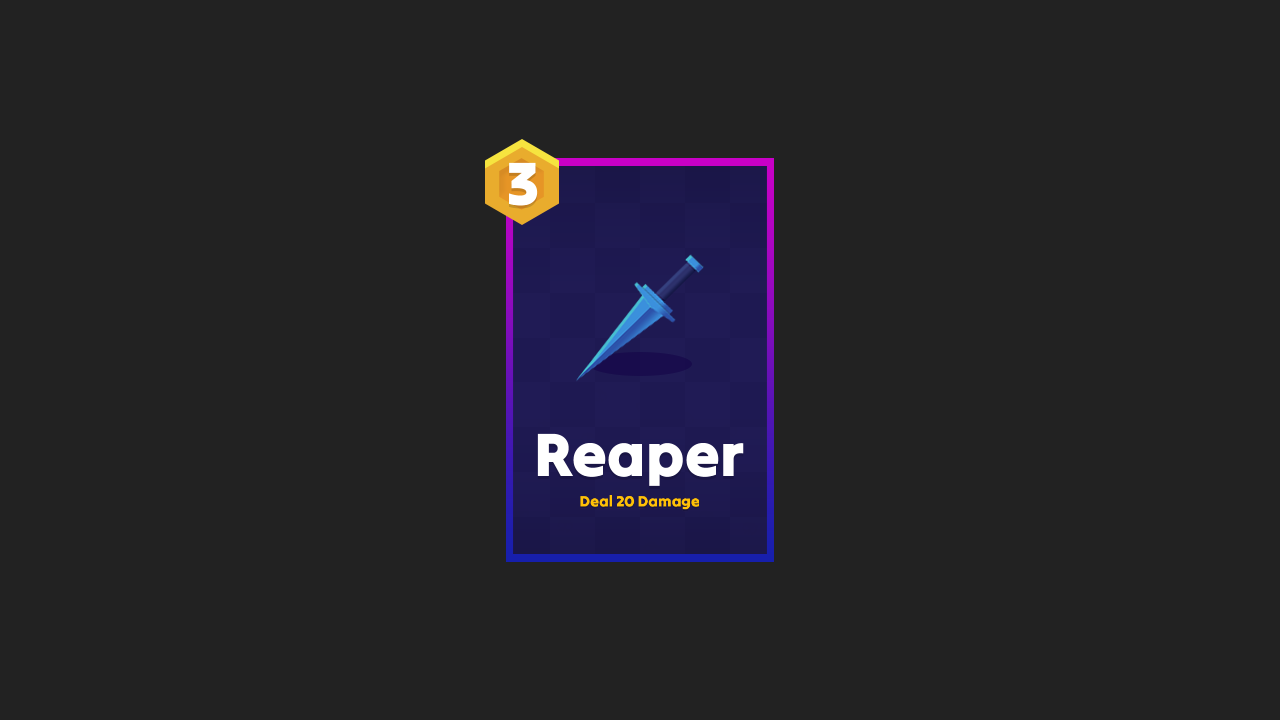
In-game implementation
1. Load prefab
2. Modify Prefab
3. Prefab Hierarchy
4. Prefab Make
5. Custom Prefab Class
6. Prefab Bind
7. Override
Geting Started
In the example res folder you will find the card, button and board prefabs used in the code examples.
Before start: install the library from haxelib:
haxelib install prefab
Alternatively the dev version of the library can be installed from github:
haxelib git prefab https://github.com/nayata/prefab.git
Include the library in your project’s .hxml:
-lib prefab
Load Prefab
Loading a card.prefab and adding it to the scene.
class App extends hxd.App {

	static function main() {
		new App();
	}

	override function init() {
		engine.backgroundColor = 0x222222;
		hxd.Res.initLocal();

		// Add `card.prefab`
		var card = hxe.Lib.load("card", s2d);
		card.x = s2d.width * 0.5;
		card.y = s2d.height * 0.5;
	}
}
At this point, the prefab is successfully created and added to the scene. However, loading a prefab is usually only the first step.
In a real game, a prefab is rarely static — you typically want to:
- change text labels (for example, scores, names, or descriptions),
- access and modify visual elements,
- enable or disable parts of the prefab,
- or react to game logic and user input.
To do this, you need a way to access the objects inside the prefab.
Modify Prefab
Once a prefab is created and placed in the scene, the next step is to access and modify its internal objects.
Each hxe.Prefab provides the get method, which allows you to retrieve an object
from the prefab hierarchy by its name and then work with it in code.
In this example, card.prefab and button.prefab are added to the scene. After that, the text of the “title” text field inside card prefab is changed to “Deem”.
From button.prefab, an h2d.Interactive named “input” is retrieved, and mouse
events are assigned to it.
Note: In this example, prefabs are created directly and added to the scene using the Prefab constructor.
import hxe.Prefab;

class App extends hxd.App {
	var card:Prefab;
	var button:Prefab;


	static function main() {
		new App();
	}


	override function init() {
		engine.backgroundColor = 0x222222;
		hxd.Res.initLocal();

		// Add `card.prefab`
		card = new Prefab("card", s2d);
		card.x = s2d.width * 0.5;
		card.y = s2d.height * 0.5 - 64;

		// Set card prefab title text
		var title:h2d.Text = card.get("title");
		title.text = "Deem";

		// Get type of the `title` object:
		var type = card.typeof("title");
		trace(type);

		// Add `button.prefab`
		button = new Prefab("button", s2d);
		button.x = s2d.width * 0.5;
		button.y = s2d.height - 128;

		// Set button prefab label text
		var label:h2d.Text = button.get("label");
		label.text = "Select";

		// Get interactive from button prefab
		var input:h2d.Interactive = button.get("input");
		input.onClick = onClick;
		input.onOver = onOver;
		input.onOut = onOut;
	}


	function onClick(e:hxd.Event) {
		var title:h2d.Text = card.get("title");
		title.text = title.text == "Grimm" ? "Reaper" : "Grimm";
	}


	function onOver(e:hxd.Event) {
		button.get("over").visible = true;
	}


	function onOut(e:hxd.Event) {
		button.get("over").visible = false;
	}
}
Type safety and the get method
For methods and properties that belong to the base h2d.Object, you do not need to
explicitly specify a class - you can directly use the result of get:
button.get("over").visible = true;
However, the get method also supports explicit type checking.
It accepts an optional class parameter, which ensures that the retrieved object
matches the expected type. If the object exists but does not match the specified
class, null is returned.
var input = button.get("input", h2d.Interactive);
If no class is provided, the object is returned directly using an unsafe cast.
var input:h2d.Interactive = button.get("input");
This makes get flexible: you can rely on quick access when you are confident about
the prefab structure, or enforce strict type safety when needed.
Getting object types
In addition to get, hxe.Prefab also provides the typeof method, which allows you
to retrieve the actual class type of an object from the prefab hierarchy.
Prefab Hierarchy
Prefab hierarchy and childrens.
The get method of a hxe.Prefab is used to get a specific object by the specified name.
The hxe.Prefab also has a all method with which you can get an array of objects of the specified type. For example, we can get all objects with the h2d.Bitmap or h2d.Text type.
The prefab hierarchy is a key->value Map so objects in it are not equal to objects in the prefab children array. This is because objects with non-unique names overwrite each other.
import hxe.Prefab;

class App extends hxd.App {
	var board:Prefab;
	var button:Prefab;


	static function main() {
		new App();
	}


	override function init() {
		engine.backgroundColor = 0x222222;
		hxd.Res.initLocal();

		// Add `board.prefab`
		board = new Prefab("board", s2d);
		board.x = s2d.width * 0.5;
		board.y = s2d.height * 0.5 - 64;

		// Add `button.prefab`
		button = new Prefab("button", s2d);
		button.x = s2d.width * 0.5;
		button.y = s2d.height - 128;

		// Set button prefab label text
		var label:h2d.Text = button.get("label");
		label.text = "Select";

		// Get interactive from button prefab
		var input:h2d.Interactive = button.get("input");
		input.onClick = onClick;
		input.onOver = onOver;
		input.onOut = onOut;
	}


	function onClick(e:hxd.Event) {
		// Get all objects from `board` prefab hierarchy,
		// that matched with `Prefab` class (2 cards)
		var cards:Array<Prefab> = board.all(Prefab);

		for (card in cards) {
			if (card.has("image")) trace(card.get("image").name);

			// Get all `h2d.Text` objects from this prefab hierarchy
			// Set all text to "text"

			// Note: the last card did not change its text because the prefab hierarchy
			// allows only unique object names. As a result, the `cards` array contains
			// only two prefabs — one prefab was overwritten by another prefab
			// with the same name.
			var texfields = card.all(h2d.Text);
			for (texfield in texfields) {
				texfield.text = "text";
			}
		}

		// Get all `h2d.Object` from `board` prefab children
		for (child in @:privateAccess board.children) {
			trace(child.name, child.x);
		}
	}


	function onOver(e:hxd.Event) {
		button.get("over").visible = true;
	}


	function onOut(e:hxd.Event) {
		button.get("over").visible = false;
	}
}
Note: the last card did not change its text because the prefab hierarchy allows only unique object names. As a result, the cards array contains only two prefabs - one prefab was overwritten by another prefab with the same name.
Prefab Make
We can create a custom class extending hxe.Prefab that declares and stores all required fields of the prefab.
When such a prefab is instantiated, its visual content is created automatically using hxe.Lib.make, and the corresponding objects from the prefab hierarchy are assigned to the fields of this class.
After the prefab has been fully created and all objects are instantiated, the init method is called.
This method can be used to define the prefab’s behavior - for example, to set up interactions, connect it to game logic, or configure runtime state.
import hxe.Prefab;

class App extends hxd.App {
	var board:Prefab;
	var button:Button; // Now this is the `Button`


	static function main() {
		new App();
	}


	override function init() {
		engine.backgroundColor = 0x222222;
		hxd.Res.initLocal();

		// Add `board.prefab`
		board = new Prefab("board", s2d);
		board.x = s2d.width * 0.5;
		board.y = s2d.height * 0.5 - 64;

		// Make `Button` class instance from `button.prefab`
		button = new Button("button", s2d);
		button.x = s2d.width * 0.5;
		button.y = s2d.height - 128;

		// Label and interactive alredy exist
		button.onClick = onClick;
		button.text = "Select";
	}


	function onClick() {
		var card:Prefab = board.get("grimCard");

		var title:h2d.Text = card.get("title");
		title.text = title.text == "Grimm" ? "Reaper" : "Grimm";
	}
}
Button.hx
class Button extends hxe.Prefab {
	var over:h2d.Object;
	var input:h2d.Interactive;
	var label:h2d.Text;

	public var text(default, set):String = "text";


	override function init() {
		input.onClick = function(e:hxd.Event) { onClick(); };
		input.onOver = onOver;
		input.onOut = onOut;
	}

	public dynamic function onClick() {}

	function set_text(v) {
		return text = label.text = v;
	}

	function onOver(e:hxd.Event) {
		over.visible = true;
	}

	function onOut(e:hxd.Event) {
		over.visible = false;
	}
}
Custom Prefab Class
Prefabs can contain other prefabs inside their hierarchy. Such linked prefabs are loaded by the library as regular hxe.Prefab instances by default.
However, a linked prefab can also be assigned a custom class.
In the previous section, a Button class extending hxe.Prefab was created. This class can now be reused as part of a more complex UI structure, such as a menu screen.
- Create a new prefab and add card.prefab and button.prefab to it.
- Assign the
Buttonclass to button.prefab. - Save the new prefab as ui.prefab.
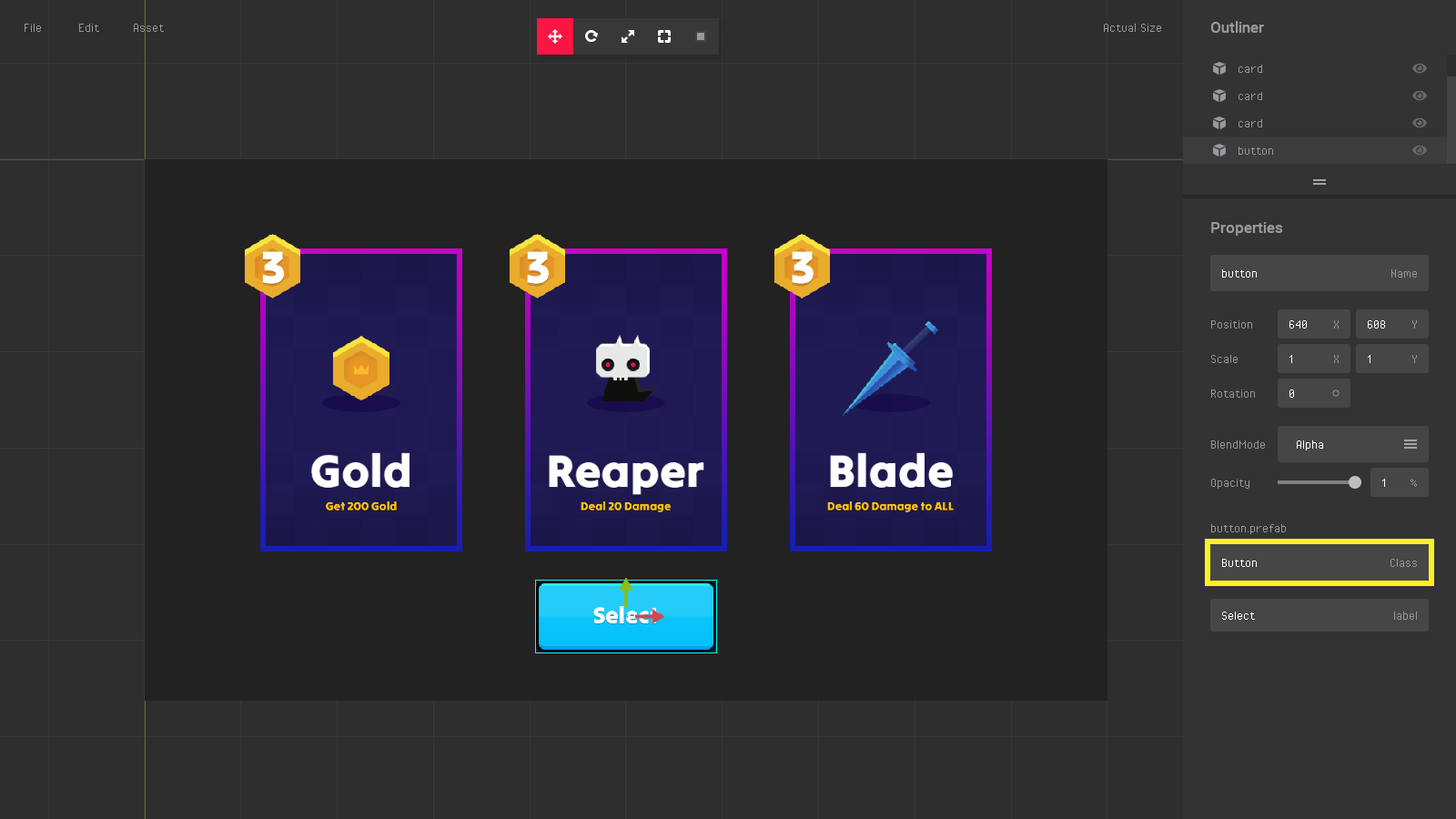
When this prefab is loaded, the linked button.prefab will be instantiated as a Button object instead of a hxe.Prefab. This allows the composed prefab to expose
fully functional, behavior-aware elements while keeping the structure modular and reusable.
import hxe.Prefab;

class App extends hxd.App {
	var screen:Prefab;
	var button:Button;


	static function main() {
		new App();
	}


	override function init() {
		engine.backgroundColor = 0x222222;
		hxd.Res.initLocal();

		// Add `ui.prefab`
		screen = new Prefab("ui", s2d);

		// Get `button.prefab` from `ui`
		button = screen.get("button");
		button.onClick = onClick;
	}


	function onClick() {
		button.text = button.text == "Select" ? "Selected" : "Select";
	}
}
Prefab Bind
If you want to use a prefab and at the same time don’t want to change your class - you can use the bind method of the hxe.Lib library to “inject” the required prefab.
Button.hx extending h2d.Object
class Button extends h2d.Object {
	var over:h2d.Bitmap;
	var input:h2d.Interactive;
	var label:h2d.Text;

	public var text(default, set):String = "text";


	public function new(?parent:h2d.Object) {
		super(parent);

		// Bind `button.prefab`
		hxe.Lib.bind("button", this);

		input.onClick = function(e:hxd.Event) { onClick(); };
		input.onOver = onOver;
		input.onOut = onOut;
	}

	public dynamic function onClick() {}

	function set_text(v) {
		return text = label.text = v;
	}

	function onOver(e:hxd.Event) {
		over.visible = true;
		label.textColor = 0x333333;
	}

	function onOut(e:hxd.Event) {
		over.visible = false;
		label.textColor = 0xffffff;
	}
}
Override
Using the editor you can override some values of objects in the prefab. You can also do this dynamically by specifying the required parameters.
import hxe.Prefab;

class App extends hxd.App {
	var card:Prefab;


	static function main() {
		new App();
	}


	override function init() {
		engine.backgroundColor = 0x222222;
		hxd.Res.initLocal();

		// Add `card.prefab` with override fields
		// typedef Field = { name : String, type : String, value : String };

		var field = { name : "image", type : "bitmap", value : "sword" };

		var card = new Prefab("card", s2d, [field]);
		card.x = s2d.width * 0.5;
		card.y = s2d.height * 0.5;
	}
}