Echo Physics
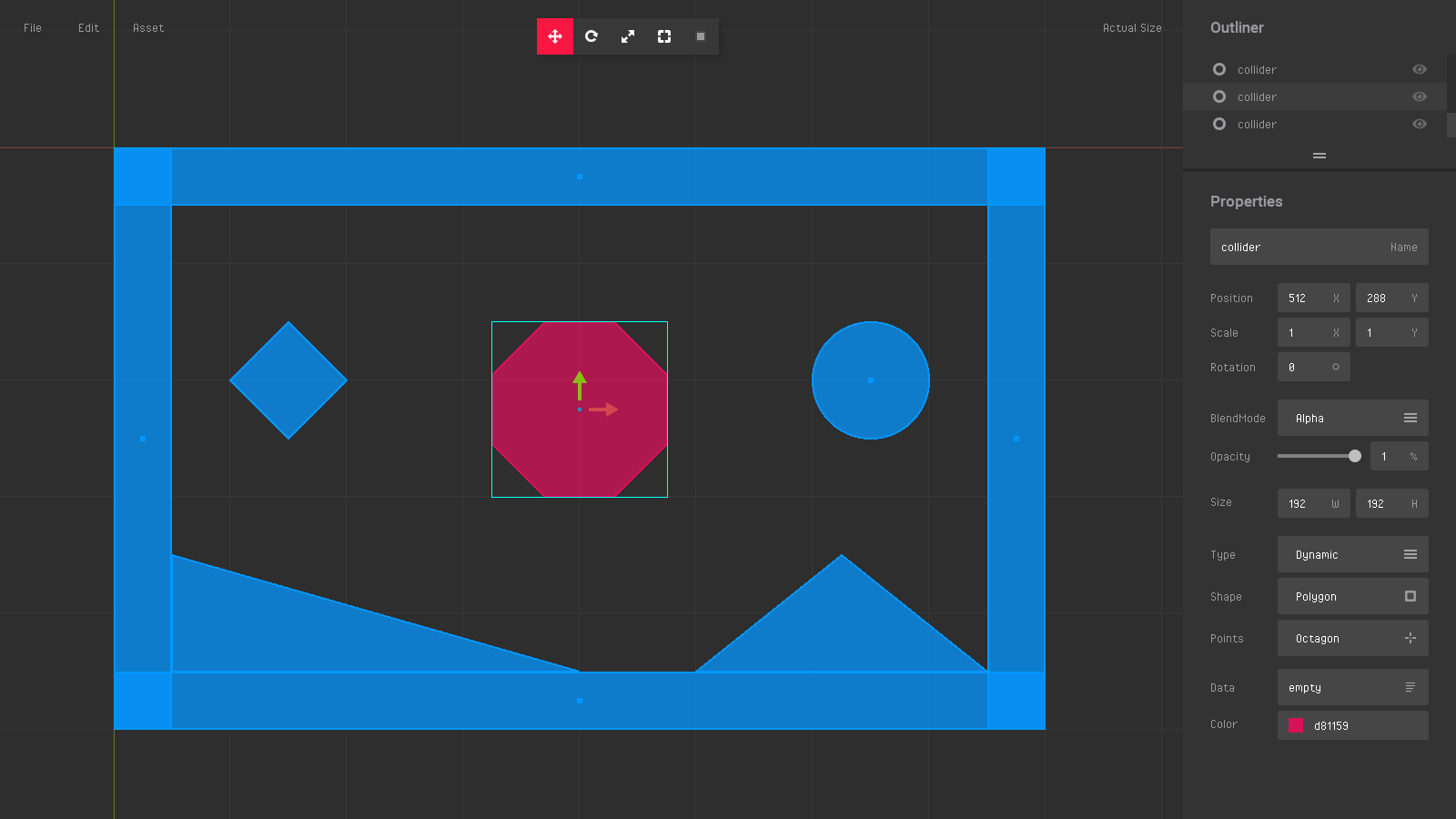
Using HEXE Collider Prefabs with Echo Physics
HEXE allows you to visually construct collision geometry and convert it into Echo Physics bodies at runtime.
Before start
This example uses Heaps, Echo Physics, and HEXE runtime prefab data.
Add the required libraries to your compile.hxml:
-lib prefab
-lib echo
Creating Colliders in Hexe
In the Hexe editor:
- Create a prefab file (e.g. level.prefab)
- Add Collider entries
- Set Collider properties
Loading the Prefab
In Hexe, prefabs are created and used as visual objects. Because of this, prefabs with the type collider cannot be instantiated directly as runtime objects.
Instead, collider prefabs are treated as data containers. The required collision information is read from the prefab and then used to manually construct Echo bodies.
Prefab data can be loaded using hxe.Lib.read:
var prefab = hxe.Lib.read("level");
The prefab may contain multiple child entries of different types. Only entries with the type collider are relevant for physics and should be filtered explicitly:
for (entry in prefab.children) {
	// Skip non-Collider entries
	if (entry.type != "collider") continue;

	// Collider data is used here to create Echo bodies
}
Each collider entry provides position, dimensions, rotation, shape type, and additional fields required to build an Echo body.
Static box colliders:
if (entry.body == STATIC && entry.shape == BOX) {
	var rotation = entry.rotation != null ? hxd.Math.radToDeg(entry.rotation) : 0;

	world.add(new Body({
		mass: STATIC,
		x: entry.x,
		y: entry.y,
		material: {elasticity: 0.3},
		rotation: rotation,
		shape: {
			type: RECT,
			width: entry.width,
			 height: entry.height
		}
	}));
}
Static polygon colliders:
if (entry.body == STATIC && entry.shape == POLYGON) {
	var rotation = entry.rotation != null ? hxd.Math.radToDeg(entry.rotation) : 0;
	var vertices = parsePolygon(entry.path, entry.width, entry.height);

	world.add(new Body({
		mass: STATIC,
		x: entry.x,
		y: entry.y,
		material: {elasticity: 0.3},
		rotation: rotation,
		shape: {
			type: POLYGON,
			vertices: vertices
		}
	}));
}
Parsing Polygon Vertices
Polygon colliders store their vertices in the path field as a comma-separated string of coordinates. This data must be parsed and converted into Echo Vector2 values:
function parsePolygon(str:String, width:Float, height:Float):Array<Vector2> {
	var parts = str.split(",");
	var verts:Array<Vector2> = [];

	for (i in 0...Std.int(parts.length / 2)) {
		var x = Std.parseFloat(parts[i * 2]);
		var y = Std.parseFloat(parts[i * 2 + 1]);
		verts.push(new Vector2(x, y));
	}

	return verts;
}
Debug Rendering
Echo physics bodies can be visualized using the Echo ‘HeapsDebug’ renderer:
debug.draw(world);
Complete Example
A working example project is available here: hexe-echo